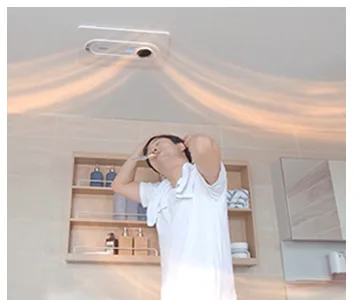
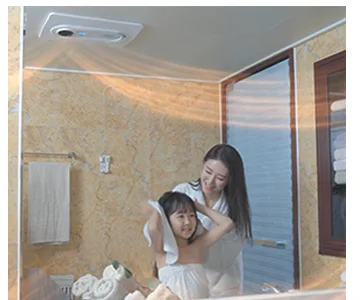
Four bathroom problems solved by one ceiling unit. Ventilate, heat, dehumidify, and dry — in a single BLDC-powered fitting with six integrated safety devices. Replace the separate fan and heater with one Korean-engineered unit, sourced through DEMORE.
A bathroom has four competing requirements that conventional fittings address with separate products: a ventilation fan to remove odour and humidity, a wall heater for warmth in winter, a dehumidifier or dry mode to prevent mould, and a body-dry function for post-shower comfort. Each product is a separate installation, a separate electrical circuit, and a separate maintenance item.
This all-in-one ceiling unit combines all four functions in a single fitting. One cutting, one wiring run, one control panel — and no separate wall heater eating tile space. The unit is driven by a BLDC (brushless DC) motor that maintains constant airflow regardless of the duct static pressure, and it incorporates six integrated safety devices to protect a bathroom environment where electricity and water coexist.
Designed and manufactured in Korea, where the bathroom ventilation heater fan is a standard category in high-rise residential and hotel construction. Sourced for global buyers through DEMORE.
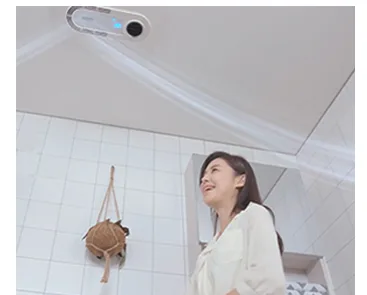
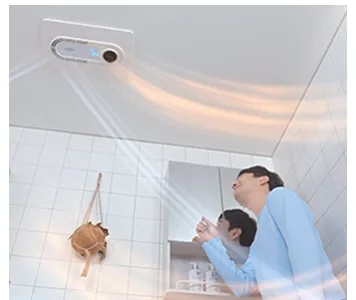
Each mode addresses a distinct bathroom use case — selected via a single control panel or wall switch.
Continuous extraction of bathroom air — odour, steam, and humidity — through the exhaust duct. The BLDC motor maintains constant airflow volume regardless of duct resistance, so the stated extraction rate is the actual extraction rate in any installation.
Recirculates warm air into the bathroom for pre-shower warmth or cold-morning comfort. Replaces the wall-mounted electric panel heater in bathrooms where wall tile space is limited or where a single-control solution is required.
Active moisture removal from the bathroom air and surfaces after showering. Reduces mould-risk humidity to a target level faster than passive ventilation. Particularly relevant in high-humidity climates and sealed bathroom designs with limited natural ventilation.
Warm-air flow directed for post-shower body drying — a comfort feature common in Japanese and Korean premium bathroom fittings that eliminates the need to run a separate fan heater from outside the shower cubicle.
Ventilation and heating can typically run together — extracting stale air while maintaining comfort temperature. Specific mode combinations available are confirmed in the product technical specification, available through DEMORE.
A single control panel or multiple wall switches operate all four modes. Remote control and smart-home integration options [확인 필요] — confirm with DEMORE for your project specification.

Why does one unit matter? Beyond the installation cost saving, a combined unit means one control point for four functions. Users do not need to locate and operate multiple switches. In hotel rooms, this also means fewer guest-facing control points and simpler housekeeping instructions.
In new construction, it also means one ceiling penetration, one electrical drop, and one element in the maintenance schedule instead of three or four.
The motor is the most important component in a ventilation fan — it determines whether the stated airflow is actually delivered in your installation.
Conventional AC motors are pressure-sensitive: the more resistance in the duct — sharp bends, long runs, fine grille filters — the more the airflow drops. The nameplate airflow figure is measured in ideal lab conditions, not in an actual duct installation.
BLDC (brushless DC) motors compensate automatically. The motor controller reads the actual operating load and adjusts RPM to maintain the target airflow volume, regardless of duct resistance. What you specify is what the bathroom gets.
Additional BLDC advantages: lower energy consumption than AC motors at equivalent output; longer service life (no brushes to wear); quieter operation at all speeds; and compatibility with variable-speed control for energy optimisation.

A bathroom is the most demanding electrical environment in a building. The unit incorporates six integrated safety devices to address the specific risks of combining electricity, heat, and water.
Automatically disconnects power if the unit reaches an unsafe temperature — the primary protection against overheating in the heating element.
A secondary thermal sensor triggers shutdown before the thermal cutoff threshold — a two-stage temperature management system.
The electrical housing is rated for bathroom environment — protection against steam condensation on internal components.
Three further integrated safety mechanisms [확인 필요 — specific device types confirmed in full technical documentation, available through DEMORE]. The full six-device list is published in the manufacturer's technical specification.
As a fixed electrical fitting with a heating element, the unit should be installed by a qualified electrician in accordance with local electrical and building codes for bathroom zones.
The complete safety device list, IP rating, electrical specification, and installation requirements are in the manufacturer's technical documentation. Request through DEMORE.
The unit is designed for ceiling-mount installation in a standard bathroom ceiling — concrete, gypsum, or suspended — with a duct run to the exterior or a common extract shaft. The single integrated housing means one ceiling penetration replaces what would otherwise be separate penetrations for a fan and a heater.
Power and control wiring is consolidated to a single electrical drop. Installation time is shorter than fitting two separate units. The finished ceiling presents a single grille panel — a cleaner visual result than two separate fittings.
Electrical specification, duct connection size, and installation requirements are published in the technical data sheet. Contact DEMORE to request the full installation guide and confirm specifications for your project.

High-rise apartment and condominium construction where a combined unit reduces installation cost and ceiling complexity per unit.
Guest room bathrooms where a single-control unit simplifies guest interaction and reduces maintenance call frequency.
Replacement of existing separate fan and heater with a single fitting — reduces wall and ceiling work versus maintaining two separate units.
Compact bathroom designs where wall heater space is premium and a ceiling unit solves the heating function without sacrificing tile.
Higher-humidity environments where the dehumidify/dry mode prevents mould growth and reduces the ventilation maintenance burden.
Office buildings, retail, and public facilities where bathroom maintenance efficiency justifies the integrated-unit approach.
Designed and manufactured by a Korean electrical appliance maker in a category where Korean domestic standards are demanding — Korean apartments require ventilation heater fans to meet strict performance and safety requirements.
Brushless DC motor technology delivers the stated airflow regardless of duct resistance — a technical commitment to real-world performance, not laboratory-condition specification.
Six safety mechanisms specifically designed for the bathroom environment where a heating element operates in proximity to steam and moisture.
A single ceiling-mount housing replaces what would otherwise be separate fan and heater installations — reducing both project cost and ongoing maintenance complexity.
Technical data sheet, wiring diagram, installation guide, and safety device specification are available through DEMORE for buyers and installing electricians.
DEMORE is the export sourcing partner. One English-speaking contact handles specification, quotation, and shipping from Korea.
Yes — that is its design purpose. The warm-air and body-dry modes provide the heating function previously handled by a separate wall panel heater. The ventilation mode replaces the ceiling exhaust fan. One ceiling-mount unit handles all four bathroom functions with a single control panel.
A standard AC fan motor produces a rated airflow at a specific duct resistance. Add a longer duct run, additional bends, or a finer intake grille, and the actual airflow drops significantly below the nameplate figure. A BLDC motor reads the load and adjusts speed to maintain the target airflow — so the bathroom gets the ventilation rate the product specifies, in the actual installation, not just in a test lab.
Electrical specification — voltage, current draw per mode, circuit breaker rating, and wiring diagram — is in the technical data sheet. Contact DEMORE to request the TDS and confirm compatibility with your project's electrical standards.
Appropriate room size depends on the unit's extraction rate (m³/h) relative to the bathroom volume. The technical data sheet specifies recommended room size ranges. Contact DEMORE for confirmation on your bathroom dimensions.
Smart-home and remote control compatibility [확인 필요] — confirm with DEMORE for your target specification and market.
Contact DEMORE at [email protected] with project quantity, target market, and any electrical specification requirements. DEMORE typically replies within one business day.