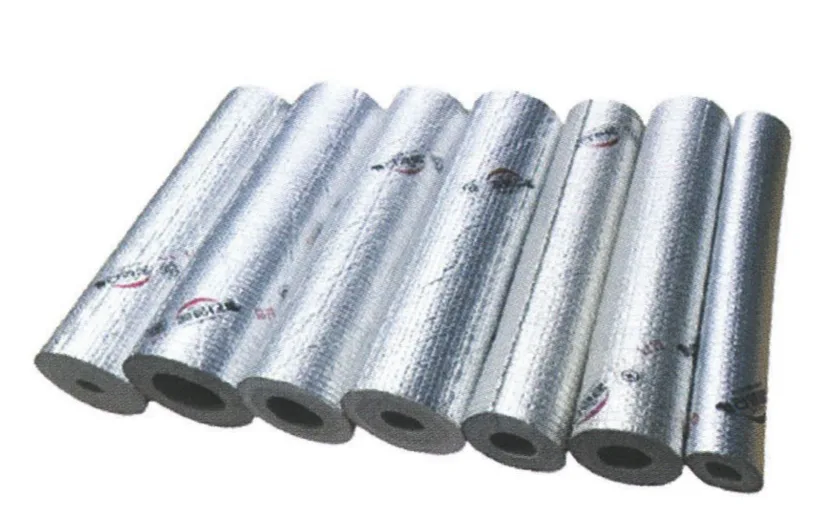
A KS-certified, chemically cross-linked polyethylene (XPE) insulation system for piping and ductwork — engineered and manufactured in Korea by one of the country's top-three XPE insulation makers, and sourced for global buyers through DEMORE.
This pipe insulation is produced by a manufacturer that ranks among Korea's top three makers of cross-linked polyethylene (XPE) insulation, operating from a dedicated plant in Jeolla Province, South Korea. The company has specialized in cross-linked PE foam since 2005 — roughly twenty years of production experience concentrated on this single material family.
The line has held Korean Industrial Standards (KS) product certification since 2007 and is manufactured under an ISO 9001:2015 quality system. Its insulation is installed today across piping and duct lines in apartment towers, infrastructure and plant projects built by Korea's leading tier-1 construction groups and public housing programs.
For buyers, that history matters for one practical reason: the product can be specified against any piping condition — hot or cold, exposed or buried, straight runs or complex valve clusters — with format, wall thickness, and facing matched to the job.
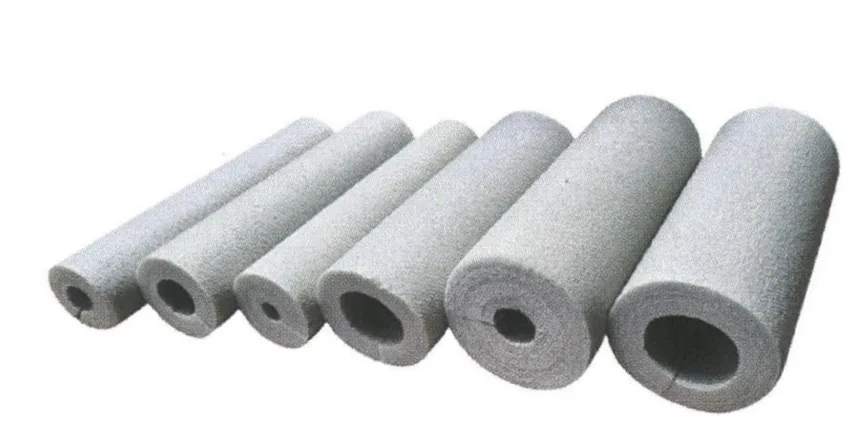
Ordinary PE foam is held together physically. Cross-linked PE foam (XPE) is bonded chemically — the polymer chains are linked into a three-dimensional network during foaming. The result is a fine, uniform closed-cell structure with smooth skinned surfaces on both faces: lighter, springier, and far more durable than non-cross-linked foam.
Millions of independent closed cells block conductive and convective heat flow. Measured thermal conductivity of 0.036 W/m·K keeps hot lines hot, cold lines cold, and energy bills down.
The closed-cell structure absorbs essentially no water — 0.007 g/100cm² in accredited testing. Wet insulation loses its value entirely; XPE never gets the chance to soak.
Very low water absorption plus stable surface temperature means cold-water lines stay dry — protecting pipes from corrosion and buildings from moisture damage.
Made from pure polyethylene polymer, the foam resists chemicals and does not deform on contact — a semi-permanent material even in harsh plant environments.
The fine uniform cell structure absorbs impact energy and dampens noise transmission along pipe runs better than conventional insulation.
Light to carry, easy to cut, flexible around elbows and valves, and standardized in dimensions — installs fast and finishes clean, with no fiber dust to handle.
Figures below are from accredited third-party laboratory testing (2025) of the P2 flame-retardant grade, set against the requirements of the Korean Industrial Standard KS M 3862:2024 for cross-linked polyethylene thermal insulation.
| Property | Measured result | KS M 3862 (P2) requirement | Method |
|---|---|---|---|
| Thermal conductivity (23°C) | 0.036 W/m·K | ≤ 0.043 W/m·K | KS M 3862 heat-flow meter |
| Tensile strength | 25.2 N/cm² | ≥ 16.0 N/cm² | KS M 3862 : 2024 |
| Water absorption | 0.007 g/100cm² | ≤ 0.1 g/100cm² | KS M 3862 : 2024 |
| Apparent density | 26.3 kg/m³ | — | KS M ISO 845 : 2012 |
| Thickness shrinkage (90±2°C) | Within limit | ≤ 7% | KS M 3862 : 2024 |
| Max service temperature | 90°C | P2 class | All non-steam piping |
Test reports available on request through DEMORE. Values shown are from the manufacturer's 2025 accredited test reports.
Insulation gets compressed — during transport, installation, and years of service. Foam that stays compressed loses insulating thickness. XPE recovers about 90% of its shape, roughly double the recovery of alternatives.
| After 12 months | XPE (this product) | Urethane foam | EPS |
|---|---|---|---|
| Discoloration | None | Turned dark brown | None |
| Shape | Unchanged | Weathered, shedding | Weathered, shedding |
| Surface | Unchanged | Hardened, eroded | Eroded, uneven |
| Shrinkage | Almost none | Shrinkage | Unmeasurable (shedding) |
The flame-retardant P2 grade carries the HF-1 classification under KS M ISO 9772 — the highest horizontal-burning class for cellular plastics — with results verified by independent Korean testing bodies in 2025.
Afterflame time 0.0 seconds across all five specimens; no specimen burned to the holding clamp; no flaming drips igniting cotton.
Afterflame 0.0 s (limit 5 s), afterglow 0.0 s (limit 20 s), char area ~27 cm² (limit 40), char length ~9 cm (limit 20).
Average incapacitation time above 14 minutes on all specimens (requirement: 9 minutes or more), confirming low-toxicity combustion behavior.
Fire performance applies to designated flame-retardant grades. Match grade to your local code — DEMORE will confirm the correct specification for your market.
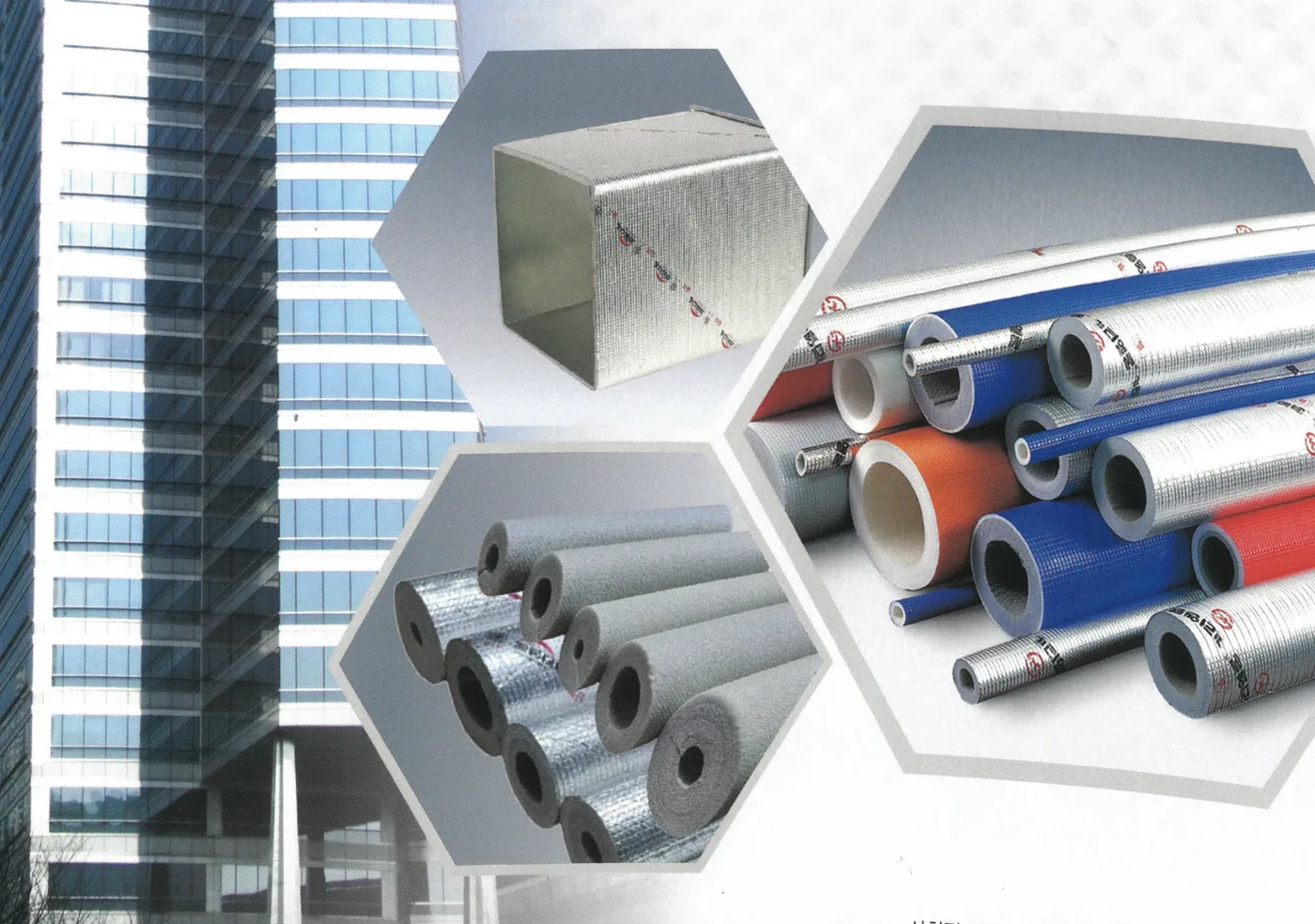
Seamless tubular sections in 2 m lengths, sized for steel pipe 15A–200A and matching copper/PB diameters, wall thickness 5–50 mm. Plain, foil-faced, and flame-retardant color versions; slit-and-clip type available for retrofit over existing lines.
Continuous roll-form XPE sheet, 5–50 mm thick, produced with smooth skinned faces. Variants: plain flame-retardant, aluminum-foil-faced, and self-adhesive backed — for tanks, ducts, and large flat or curved surfaces.
Semi-rigid high-expansion boards certified to KS M 3862 (Type P1 to 70°C, Type P2 cross-linked to 90°C). Excellent cutting, bending, and adhesion behavior — suited to square and round duct fabrication.
Matching finishing tapes and aluminum bands complete the installation with a sealed, clean, weather-resistant surface — one supplier for the full insulated line.


Standard pipe covers are supplied in 2 m lengths (1 EA = 2 m). The table below shows inner diameters against pipe standards, with bundle quantities per wall thickness. Non-standard diameters and thicknesses are produced on request.
| ID (mm) | Steel pipe | Copper / PB | 5T | 10T | 15T | 20T | 25T | 30T | 40T | 50T |
|---|---|---|---|---|---|---|---|---|---|---|
| 16 | — | 15A | 400 | 200 | 100 | 75 | 50 | 40 | 30 | 25 |
| 22 | 15A | 20A | 300 | 150 | 100 | 75 | 50 | 40 | 30 | 25 |
| 28 | 20A | 25A | 250 | 125 | 100 | 75 | 50 | 40 | 30 | 25 |
| 34 | 25A | 32A | 200 | 100 | 75 | 50 | 50 | 40 | 25 | 20 |
| 43 | 32A | 40A | 150 | 75 | 60 | 50 | 40 | 35 | 25 | 15 |
| 50 | 40A | 50A | 100 | 75 | 50 | 40 | 35 | 30 | 20 | 15 |
| 61 | 50A | 60A | 75 | 50 | 40 | 40 | 30 | 25 | 20 | 10 |
| 77 | 65A | 75A | 50 | 40 | 30 | 30 | 25 | 20 | 15 | 10 |
| 90 | 80A | 80A | 40 | 25 | 25 | 20 | 20 | 15 | 10 | — |
| 115 | 100A | 100A | 25 | 20 | 15 | 15 | 10 | 10 | 8 | — |
| 140 | 125A | 125A | 15 | 15 | 15 | 10 | 10 | 7 | — | — |
| 166 | 150A | 150A | 15 | 10 | 10 | 10 | 10 | 7 | — | — |
| 217 | 200A | 200A | 10 | 10 | 10 (slit) | 8 (slit) | 5 | 4 | — | — |
Figures = pieces per bundle at each wall thickness (T = mm). Representative rows shown; the full dimension sheet — including intermediate diameters — is available through DEMORE on request.
Insulation and freeze protection for domestic hot and cold water lines.
Heat retention on central and district heating distribution piping.
Moisture-immune closed cells make it suitable for underground runs.
Long-run heat retention for hot-spring and spa water transport.
Sheet and board formats wrap square and round ducts — buildings, plants, and rail cars.
Freeze protection for sprinkler and hydrant lines, in flame-retardant grades.
Chilled-water and refrigerant lines stay dry — no dripping, no corrosion.
The same foam serves as cushioning, void fill, and buoyancy material.
Korean Industrial Standards product certification for PE foam thermal insulation, held continuously since 2007.
Plant-wide quality management system certified since 2011, covering the full production of PE foam insulation.
National environmental label for insulation (resource circulation, energy saving, reduced hazardous substances), valid 2025–2028.
Certified to the Korean green building material group standard at the highest grade for low emissions.
Flame-retardant grades classified HF-1 under KS M ISO 9772, with 2025 third-party test reports.
Registered patents in molded mat products and heat-reflective insulation; in-house compounding → blending → extrusion → cross-linking line.
Reference installations, 2024: piping and duct lines across dozens of apartment, infrastructure, and plant projects for Korea's leading tier-1 construction groups and the national public housing authority. Project references can be shared with serious buyers on request.
DEMORE is the export sourcing partner for this line. You deal with one English-speaking contact who handles specification, sampling, quotation, production follow-up, and shipping coordination directly with the plant. Prices are quoted per inquiry — tell us your pipe schedule, required thicknesses, facing, and destination port, and we reply within one business day with pricing, minimums, and lead times.
Flame-retardant P2 grade serves continuously up to 90°C — suitable for every building line except steam. For cold service, the closed-cell structure prevents condensation on chilled-water and refrigerant lines.
Yes. Standard tooling covers steel 15A–200A with walls 5–50 mm; non-standard inner diameters, wall thicknesses, and lengths are produced to order. Send your pipe schedule and we will confirm feasibility.
Plain (skinned foam), aluminum-foil-faced for exposed or outdoor runs, self-adhesive backed sheet, and colored flame-retardant covers. Foil and finishing tape/band accessories ship from the same plant.
Yes — KS certification, ISO 9001, eco-label certificates, and 2025 third-party test reports (thermal, mechanical, flame, gas toxicity) are available through DEMORE for your regulatory file.
Both lose performance with time: urethane discolors, hardens, and erodes outdoors within a year, EPS weathers and sheds, and both recover only 0–64% after compression. XPE showed no visible degradation in the same 12-month outdoor comparison and recovers about 90% of its thickness.
Prices are not published — they depend on diameter mix, thickness, facing, volume, and destination. Send an inquiry with your requirements and DEMORE typically replies within one business day with pricing, MOQs, and lead times.